
By Kumadoh Perspective
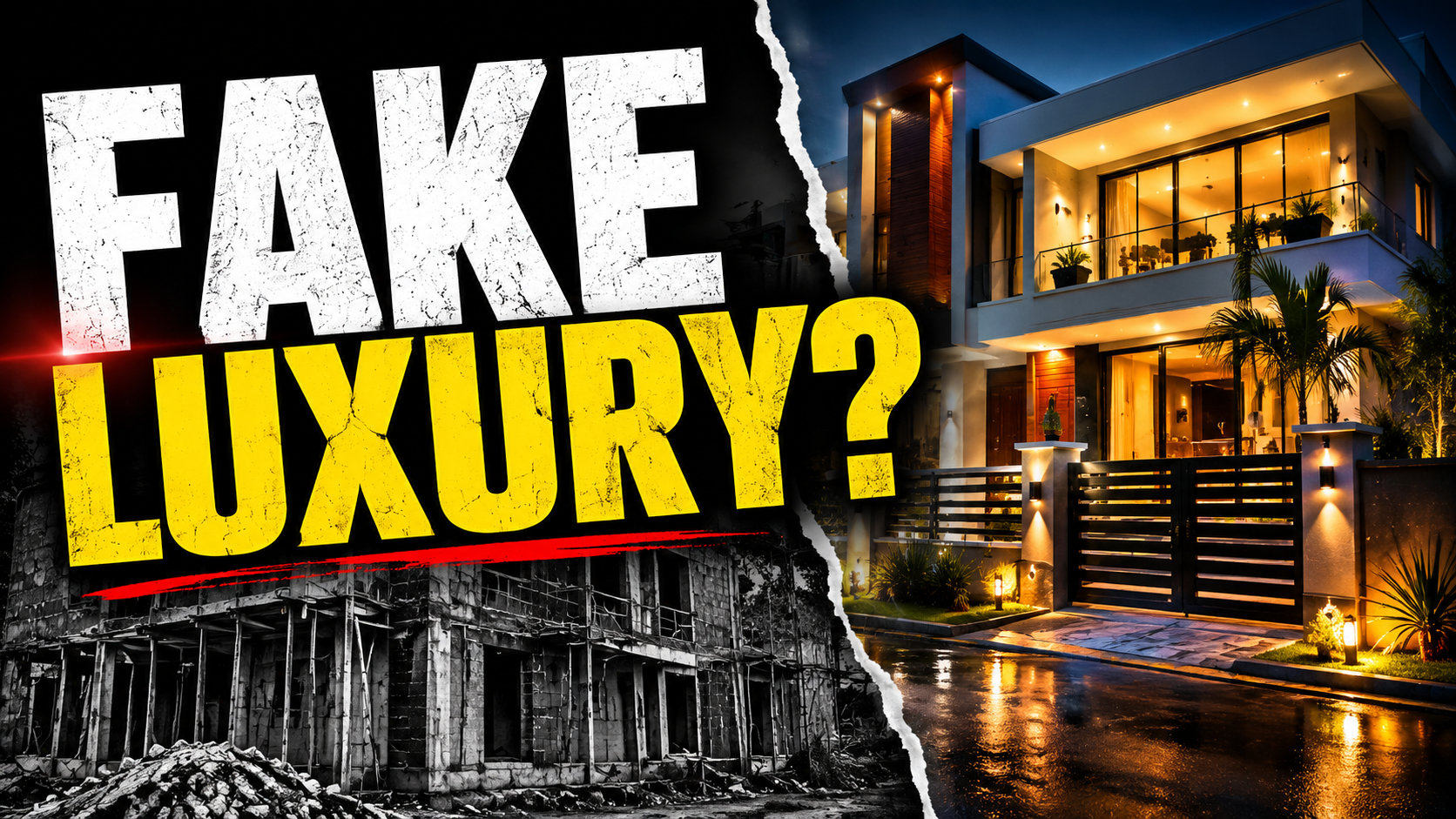
Imagine walking into a house with polished floors, dramatic lighting, a beautiful kitchen, and a price tag that suggests nothing has been overlooked.
Now ask a different question: What exactly are you paying for—the appearance of luxury or the quality of the property?
That is the question at the heart of the fake luxury debate in Accra. Before you fall in love with the photographs, consider what the camera cannot establish: construction quality, ownership rights, maintenance responsibilities, and whether the promises made during the viewing will appear in your contract.
A beautiful house is not automatically a bad investment. But beauty should be the beginning of your assessment, not the end.
For anyone buying property in Ghana, the goal should be simple: understand what you are buying before paying a premium for it.
What Does “Fake Luxury” Mean in Real Estate?
In this article, fake luxury describes a gap between a property’s premium presentation and the quality, functionality, or services actually delivered.
Consider a hypothetical apartment advertised with high-end finishes, reliable backup power, secure parking, and professional management. The questions are whether the specified finishes are installed, what the backup system actually powers, whether parking is allocated, and who is responsible when something stops working.
These are different issues from whether you like the interior design.
It is also important to separate disappointing quality from proven fraud. A defect, an ambitious asking price, or an unattractive layout is not, by itself, evidence of a scam. Suspected deception requires investigation rather than assumptions.
The purpose of this discussion is not to label Accra’s luxury developments as fraudulent or claim a statistically established increase in fraud. It is to help buyers test the promises behind the marketing.
Watch the Kumadoh Perspective Episode
Watch “Why Fake Luxury Scam is Taking Over Accra” alongside this buyer-awareness guide.
Why Fake Luxury Marketing Can Be Persuasive
The following are ways misleading luxury marketing can work—not findings about how frequently they occur in Accra.
Appearance Can Replace Evidence
A property video can show you a kitchen. It cannot establish whether the plumbing concealed behind that kitchen was installed correctly.
Treat photographs and walkthroughs as tools for deciding which properties deserve closer attention. Do not treat them as inspection reports.
RICS explains that a professional home survey assesses a property’s condition and identifies visible problems through an inspection and written report. It also notes that hidden or inaccessible areas may require further investigation. Although its cited consumer guide is UK-focused, the distinction between a viewing and a technical assessment is useful for buyers elsewhere.
The practical lesson is straightforward: use the pictures to shortlist the property, then use evidence to evaluate it.
Prestige Can Distract From Practical Questions
There is nothing wrong with wanting an impressive home or a particular address. The problem begins when the emotional appeal of the purchase prevents you from asking ordinary questions.
Can you park comfortably? Is there useful storage? Does the layout work for your family? Can you obtain replacement parts for the installed fittings? Are the communal areas suitable for the number of residents?
A useful personal test is this:
Would you still consider the property good value without the expensive furniture, flattering lighting, and prestigious address in the advertisement?
The answer will not determine its market value, but it can clarify what matters to you.
Promises Can Be Mistaken for Deliverables
When assessing off-plan property in Ghana, separate what is already built from what is illustrated or promised.
Ask for a written specification covering the unit’s dimensions, finishes, appliances, parking arrangements, shared facilities, and delivery milestones. Have your lawyer examine how those commitments are reflected in the agreement, including what happens when specifications change or completion is delayed.
Do not evaluate an unfinished project as though every element of its marketing presentation already exists.
Look Beyond the Finishes: What Should You Inspect?
The question is not simply whether the tiles look expensive. It is whether the building deserves the confidence you are placing in it.
Water Entry, Drainage, and Moisture
Ask your inspector to investigate signs of moisture around windows, ceilings, bathrooms, balconies, and external walls.
RICS identifies issues such as defective roofing, failed seals, plumbing leaks, and drainage problems as possible sources of unwanted moisture. Its guidance stresses the importance of finding the source rather than treating only the visible symptoms.
For your viewing, request access to the less photogenic parts of the property. Look at the service areas, external drainage, and spaces around the building—not just the furnished living room.
Ask about previous leaks, repairs, and flooding. Where concerns arise, request an independent assessment rather than relying on a verbal assurance.
The Inspection’s Scope and Limitations
Commission an appropriately qualified, independent professional to assess the property, and agree in advance what the inspection will cover.
Ask whether specialist electrical, plumbing, structural, or drainage investigations are necessary. A general visual inspection should not be presented as proof that every concealed component is sound.
RICS specifically distinguishes a condition survey from a lender’s valuation and explains that further investigations may be necessary where access or specialist knowledge is limited.
A high valuation and a clean bill of structural health are not the same document.
Functional Design
During the viewing, imagine an ordinary day rather than a housewarming party.
Check where laundry will be dried, where cleaning equipment will be stored, how visitors will park, and how maintenance workers will reach equipment. Consider whether the rooms remain practical when furnished with the items you actually own.
These are personal suitability tests, not universal definitions of luxury. But they are worth completing before paying for a home you may find inconvenient to live in.
Verify the Amenities, Not Just the Brochure
For luxury apartments in Accra, ask detailed questions about shared facilities before assigning them value.
| Advertised feature | Questions to ask |
|---|---|
| Backup electricity | What equipment does it power, and how are fuel and maintenance charged? |
| Reliable water supply | What is the water source, storage arrangement, and maintenance responsibility? |
| Secure parking | Is your space allocated in writing, and what arrangements apply to visitors? |
| Swimming pool or gym | Is it operational, who may use it, and who pays for upkeep? |
| Professional management | Which company is responsible, and what service commitments are documented? |
| Smart-home features | What works at handover, and who provides support and replacement parts? |
For an occupied building, request the relevant service records and speak with residents where possible. For a new development, request commissioning records and written operating arrangements.
A promised facility should not remain an unanswered question when you are ready to commit.
A Luxury Appearance Does Not Replace Property Due Diligence
Treat the building, the ownership documents, and the people handling the transaction as separate checks.
Check the Property Records
The Lands Commission’s published services include land certificate searches, searches of the register and registry map, and authentication of land and provisional certificates. Its Land Registration Division maintains records of land and interests in land.
Before committing to a purchase, engage an independent Ghanaian property lawyer to determine the searches and enquiries appropriate to the transaction.
Ask the lawyer to review the seller’s authority, the interest being transferred, relevant restrictions, and the relationship between the documents and the actual property. Have the appropriate survey professional check boundaries where necessary.
Also request confirmation from the relevant local authority about the approvals applicable to the development and its intended use.
Do not treat a seller-provided document as independently verified merely because it looks official.
Verify the Agent or Brokerage
Ghana’s Real Estate Agency Council provides a public registry through which buyers can check the licensing status of real estate practitioners. The council advises the public to verify practitioners before engaging in property transactions.
Request the agent’s or firm’s full registered name and licence details, then check them independently.
Practitioner verification and property verification answer different questions. Complete both rather than expecting one check to replace the other.
Hidden Property Costs: What Happens After You Get the Keys?
Before buying, request a written ownership-cost breakdown—not just the purchase price.
For an apartment, ask about the service-charge budget, what the charge excludes, how increases are approved, and whether contributions are collected for major repairs or equipment replacement.
For a standalone home, prepare your own maintenance and operating budget. Request quotations where significant costs remain uncertain.
The relevant question is not simply, “Can I afford this property?”
It is also, “Can I afford to operate and maintain it to the standard I expect?”
An Illustrative Rental-Income Example
The following figures are hypothetical and are not Accra market averages or forecasts.
Suppose a property costs GH₵2,000,000 and could generate GH₵120,000 a year in rent at full occupancy. The gross rental yield would be:
GH₵120,000 ÷ GH₵2,000,000 = 6%
Now assume vacancy and unpaid rent reduce collections by GH₵10,000, while owner-paid operating expenses total GH₵40,000.
That leaves GH₵70,000, equivalent to 3.5% of the purchase price, before financing costs, taxes, acquisition costs, and major capital expenditure.
The arithmetic illustrates why an attractive advertised rent is not the same as money available to spend.
For Ghana property investment, assess the costs and assumptions behind the income projection—not just the headline percentage.
Buying From Abroad? Build an Independent Verification Process
For diaspora property investment in Ghana, organise the purchase so that your evidence does not come exclusively from the party selling the property.
Ask an independent lawyer to report directly to you. Arrange an independent inspection with a written scope. Request dated photographs and reports that identify the exact unit, not merely a show home or another completed property.
Before each payment, establish what the payment is for, who is authorised to receive it, and what documents or verified milestones support it.
A relative can help with access and local communication. Give professional legal and technical assessments their own place in the process rather than expecting a family viewing to answer every question.
Your distance from the property should change how you organise verification—not whether you carry it out.
What Should Genuine Luxury Deliver?
A useful buying standard is that a premium property should offer more than decoration.
Look for a convincing combination of thoughtful design, documented specifications, independently assessed condition, usable amenities, transparent costs, and a clear process for resolving defects.
Ask the developer:
“Show me how the property meets its promises, how it will be maintained, and what happens when something goes wrong.”
Judge the answers by their detail and supporting evidence.
The goal is not to reject attractive homes. It is to distinguish a well-presented product from a well-supported purchase.
What Should You Do When the Property Does Not Match the Promise?
Preserve the advertisement, specifications, correspondence, payment records, contract, and inspection findings. Document the issue and seek independent legal advice about the appropriate next step.
REAC accepts complaints concerning misconduct, unethical practices, and breaches involving real estate practitioners or firms. That provides a potential reporting route, although the appropriate remedy will depend on the circumstances.
Avoid making public accusations before the facts have been properly established. Focus first on documenting what was promised, what was delivered, and the available resolution process.
Frequently Asked Questions
What is fake luxury in Accra?
Here, the term describes a mismatch between premium property marketing and the quality, functionality, or services delivered. It is a buyer-awareness description, not a finding that a particular developer has committed fraud.
Does an expensive property guarantee quality?
Do not use the asking price as a substitute for inspecting the property. Evaluate the condition, specifications, documentation, and ownership costs separately.
Should I inspect a newly built luxury home?
Arrange an independent assessment and agree its scope before committing. Professional survey guidance highlights the value of assessing condition and identifying matters requiring further investigation; newness alone should not replace that process.
How can I verify a real estate agent in Ghana?
Check the practitioner’s details through REAC’s public registry. The council provides searches intended to help the public verify licensing status before a transaction.
What should I ask before buying a luxury apartment?
Request the unit specifications, inspection findings, relevant property documents, service-charge information, parking arrangements, amenity operating details, and written defect-resolution process.
Final Thoughts: Buy the Evidence, Not Just the Image
You do not need to stop appreciating beautiful property. You need to stop asking beauty to answer questions it cannot answer.
A photograph cannot establish ownership. A furnished show home cannot demonstrate what your contract includes. An impressive entrance cannot tell you how the building will be managed.
Before buying a house or apartment in Accra, slow the decision down enough to examine the details.
Real luxury should survive scrutiny—not depend on you avoiding it.
Watch the Kumadoh Perspective episode above and join the conversation: What would convince you that a property deserves its luxury price tag?
This article provides general educational information, not individual legal, engineering, or investment advice.